Thursday, 9 January 2014

Paragraphs for Macbeth

Paragraph 1

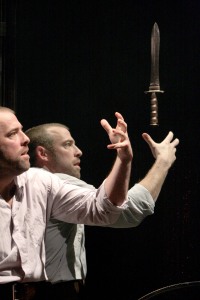
Is Macbeth mad in 2.1?


Please use formal analytical paragraph style and look at mad in the formal sense.

Paragraph 2

If you were a director, how would you stage the dagger soliloquy and why?


Please keep the following in mind when writing your opinion paragraph:

  • follow paragraph structure,
  • give quotations to support your interpretation,
  • you may use first person because this is an opinion paragraph,
  • you still must use academic language (no slang and don't write as if you were speaking).
Both paragraphs are due and will be typed up on Friday.

Writing a Formal Analytical Paragraph

Soliloquy: A long, usually serious speech that a character in a play makes to an audience and that reveals the character’s thoughts. (http://www.merriam-webster.com/dictionary/soliloquy)

Writing an analytical paragraph using quotations to support your point

  1. Topic sentence: introduce the topic of the paragraph
  2. Set up the quote: give required background info so the reader knows why you are giving the quote and can understand the quote
  3. Quotation (accurately quoted and cited)
  4. Explain how quote proves point
  5. (repeat previous 3 steps once or twice)
  6.  Closing sentence: sums up point

 Do no refer to yourself in formal analytical paragraph by saying things like "In my opinion" or using "I," "me," "you" etc. Use appropriate academic language (no slang). It is not an opinion paragraph.

Paragraph Structure (General)

·         Topic sentence
·         Support sentences (typically 3 reasons)
·         Closing sentence

Tuesday, 7 January 2014

Macbeth Act 2 Scene 1

Class Outline

http://folgereducation.files.wordpress.com/2010/10/75thmacbeth362f-dagger.jpg?w=200&h=300


  1.  In groups of 4, go over predictions for what you think will happen. Choose one that your group will share with the class.
  2. Definition of "soliloquy"
  3. Read 2.1
  4. Discuss concepts of madness and the dagger soliloquy. View examples below.
  5. Using the printed copy of the soliloquy, underline parts of the speech that you think show Macbeth is mad (crazy), and parts of the speech that make you believe he is not mad. This will be used in a written assignment.


Tuesday, 17 December 2013

Macbeth 1.1-1.5 Quotations

These are the line numbers for the quotations the class thought were the most important.

1.1
1.1.11-12*
1.2
1.2.1-3
1.2.4-7
1.2.8-9
1.2.14-18*
1.2.35*
1.2.37
1.2.43-44
1.2.51-53
1.2.57-59
1.2.63-65*
1.2.68*
1.3
1.3.14
1.3.32-37
1.3.38
1.3.39-42
1.3.49-51*
1.3.52-53
1.3.67-69*
1.3.80-81
1.3.86-90
1.3.91-92
1.3.104-105
1.3.110-111
1.3.120-122
1.3.124-125*
1.3.139-142
 1.3.146-147*
1.4
1.4.4-5
1.4.11-14
1.4.29-30*
1.4.37-39
1.4.47-51*
1.4.53-54
1.5
1.5.15-17*
1.5.38-39
1.5.42-43*
1.5.49-51*
1.5.67-68*

Wednesday, 11 December 2013

Macbeth! Wednesday and Friday classes

1. Grammar sheets: up to and including Other Uses of Present Tense
2. Recap what has happened so far.
3. Current Characters
4. Read 1.2 and 1.3
5. Get in groups
6. In your groups, look for all examples of imagery that is:

  • Light and dark
  • Blood
7. As a class, take these up and develop a full list of the first two scenes.
8. Read 1.4 and 1.5
9. Look for light and dark imagery in those scenes.

Monday, 25 November 2013

Essay Writing: Overview of Essay Writing

You will be writing an essay on your ISU book that will be 15% of your final mark.


You will create a 1500-word essay (+/- 300 words) analyzing how a big idea or theme is developed in your novel through the author’s use of various literary devices or elements. Using quotations from the book and your tracking sheets, you will argue for your interpretation of the author's message.

How To Write A Literary Essay

This is not a 5 paragraph essay! This is a 5 section essay! You will have an introduction paragraph, a conclusion paragraph, and in between 3 points. It may be 5 or more paragraphs.

The Essay Format

Section 1: Introduction Paragraph
  1. Introduces text and author. May give a 1 or 2 sentence plot summary or background information to help the reader understand the rest of the essay.
  2. Ends with thesis (1 sentence) and directional statement (1 sentence).


Section 2: The Body
This is made up of the three points to prove thesis. Each point is explained in at least a paragraph.
·    The first sentence of each point:
o    Should introduce the point (which is found in your directional statement) and how it relates to your thesis.
o    Generally does not include a quote.
·    The support:
o   Claims about the books are supported with quotes and page numbers. The body of each point gives quotations or specific examples with page numbers to support the argument, and explains why each example proves the point. Each of the three main points should have approximately three quotations that are explained.
·    The final sentence of the last paragraph for that point:
o   Sums up the full argument made for that point.
·    All internal paragraphs within a point follow paragraph format—first sentence introduces topic of paragraph, last sentence sums it up.
           
Section 3: Conclusion Paragraph
·    The first sentence rephrases your directional statement by listing again your three points in order. The thesis may be combined into this list or come right after in slightly different words.
·    Rest of the conclusion is final thoughts on how your essay is important in general terms.
·    You should not introduce new information or arguments in the conclusion. Hence, it should usually contain no quotations!


Key Terms

Thesis
·  It is the main argument of the essay.
·  Your entire essay should be dedicated to proving your thesis.
·  It is one sentence and should contain the novel’s title.
·  It is the second last sentence in your introductory paragraph.

Directional Statement
·  The last sentence in your introduction paragraph.
·  It should connect back to the thesis.
·  It should be one sentence listing in order the three points you will develop to prove your argument.
·  You can summarize each point into a few words for this sentence and then expand on the point in the first sentence of that point.
·  You MUST argue each of these points in the SAME order as you introduce them in the directional statement!
·  Stay away from saying “In this essay I will show...” There is no need to refer to the essay itself AND you should never refer to yourself as “I.”
·  Consider starting your sentence with “This is seen in...” “This is apparent when...” “[Name] shows this when...” etc.

Points: these are your three main ways you prove your thesis. They are the body of your argument. Each point can start off with a mini direction statement and wrap up the point however many paragraphs later with a conclusion sentence.

Support: this consists of the (typically) three ways you prove each point. It is made up of quotations and how you explain them.

When to break up a paragraph: When it is natural.
If you are changing the topic a bit within the main point or offering another supporting example you may find a natural point to break up your paragraphs. Make the paragraph break and then be sure to go back to those sentences you separated and adjust them to be proper final or starting paragraph sentences.

HINT: Double space your work as you are writing it. If you get to the point where a single paragraph is more than a page, it is too long. Cut it down or divide it up. 

Sunday, 3 November 2013

Mood and How the Character Feels

In many analyses of mood, I often see a bit of a gap in the way mood is proven. As we know, mood (as a literary element) is the reader's emotion/reaction to the text. People often try to explain this by describing the main character's feelings. This may be one of the ways the author creates mood, but if mood is what you are analyzing be sure you explain why the character's feelings have anything to do with mood. You might do this by explaining that the character is the protagonist in the book and the reader is supposed to empathise with him or her. It also helps to try to find an example of how mood is created in descriptions that are not directly related to the emotions of a character.

Speeches: Committees Start Up

We will be starting speeches. As I mentioned, you are the Kelly Road experts on speeches in our classroom. You will design assessment and activities with the help of myself and your peers.

Pick 1 of these 3 options that interests you the most:
-designing the rubric for speeches
-designing the learning activities/lessons for students to work on their public speaking skills and confidence
-designing the learning activities/lessons for students to work on speech writing skills

The area that interests you most will be the committee you will now be a part of.

Each committee must have 3 individuals with designated roles:
1. The chair: keeps everyone on task and focused (with positive comments)
2. Participation leader: ensures everyone's voice is heard by encouraging every individual to share his/her insight with positive comments.
3. Note-taker: uses a school laptop to record the group's ideas and notes. This is done on the computer to facilitate editing and collaboration later.

Day 1:

  1. Each student gets into a committee. 
  2. Committees begin discussions and draft proposals (rubric, lessons, handouts etc.).


Day 2 &3:
Please note, if an individual is having continued difficulty working with his/her committee or the committee does not seem to be functioning, the committee will be encouraged to delegate specific tasks for students to work on independently and then report back to the group.

  1. New individuals take on the roles from last class.
  2. The new chair reads to the group what they have so far. 
  3. Discussion on any ideas group members are not fully in agreement with, things that can be added.
  4. Groups work on finalizing details. Sub-committees may be created. For instance, if the public speaking group has a game or lesson it mentions, one sub-committee can create a lesson sheet detailing materials, time needed, and break down the activity into steps. If the writing skills group has a handout they want to have created, they can decide on the overall format and have sub-committees looking online for strong examples to provide to students on that handout.
  5. When the group feels it has everything it needs, it should present their work to the teacher for feedback.
  6. When all groups have gone through teacher feedback and revision, they will print off their work. Photocopies will be made. 
  7. Each student will read over the proposed activities, handouts, and assessment on their own. 
  8. The groups will then present their work and answer questions. 
  9. After each presentation, one of the following will occur:


  • If the committee proposal requires small changes or no changes, the class will vote on whether or not it should be finalized (with changes as discussed) or if they need to see the changes first.
  • If the committee proposal requires moderate to major changes or needs to be more developed, the committee will be sent back to work on it before re-presenting it to the class. 
    10. Finalized activities, handouts, assessments etc. will be emailed to me (mwilcox@sd57.bc.ca) to be
    distributed to the class.

Wednesday, 30 October 2013

Short Story Wrap Up

1. Silent reading and tracking sheets
2. Go to library to renew your books. Pick up a book review form. You may pick up more than one if you have
3. In class, fill out the book review form for your ISU book.
4. Go over theme for the short story. Talk about possible themes.
5. Go over handout for speeches.
6. Discuss the qualities of a good speech. Come up with a list of qualities.

Sunday, 27 October 2013

Theme

Theme:

  • an opinion about life, human nature, or society that the writer shares with the reader 
  • usually not stated directly
  • in sentence form
Theme Tips:
  • Avoid using the generic "you"
  • Theme statements should be generalized. Character names and specific settings are generally not found in themes.
Class Outline

  1. ISU reading/tracking sheets. Hand back stories.
  2. Think/Pair/Share: What is theme in literature?
  3. Look at earlier work that is starting to explore theme ("Test," "Bluffing," or tracking sheets) to discuss how it meets criteria of theme.
  4. Theme handout
  5. Read "The Forest of Odeo"
  6. Work through the steps to consider theme.
  7. If time: choose a short story or children's book and determine theme. 

Homework: Finish reading story and make notes on theme for Wednesday.

Sunday, 20 October 2013

Short Story Process

Create your full draft and analysis

  • Work on finishing up your draft story and analysis. 
  • Type it. 
  • Remember to save to your h:/ drive. If you save it in your "public html" folder it can be found by any computer at www.krss.sd57.bc.ca/~your.login (for homework purposes).
  • Print off your typed draft story and analysis. 

Self-Assessment

  •  Complete the self assessment sheet. 
  • Show this to the teacher.
  • Make any necessary changes to your story and analysis to meet the requirements.

Peer Assessment

  • Find a partner who is also done self assessing. 
  • Have him or her read your story and complete the peer assessment. 
  • Discuss the feedback.
  • If possible, complete peer assessment with a second partner.
  • Make changes to typed version based on feedback. 
  • Proofread carefully. 
  • Print off your good copy.


Read ALOUD 

  • Not done yet... 
  • Read ALOUD the printed copy of your story and analysis to a friend (if you really want to do this alone, read it ALOUD to yourself). 
  • Keep track of any confusing parts or errors. 
  • Make changes to your typed copy.
  • Proofread carefully.
  • Print off your NEW good copy.

Self-Assess Final Check

  • Read the assignment outline and rubric carefully (can be found on this blog). 
  • Read over your story and analysis one last time
  • Give yourself a mark on the rubric. 
  • If there is a significant difference (1 full level) between my mark for your assignment and your mark for yourself, we will have a meeting to discuss errors with the rubric and/or areas of need in self-assessment. 

Pre-Hand-In Check

  • Is your story and analysis 12-pt font?
  • Is your story and analysis Ariel or Times New Roman font?
  • Is your story and analysis double spaced?
  • Does your story have an original title (not Unit Assignment, Short Story etc.)?
  • Is your name on all your work?

Hand In

  • Good copy of short story
  • Draft of short story
  • Good copy of analysis
  • Rubric for short story where you assessed your work

Class Outlines: Short Story Unit Assignment

Monday

This week, the first 20 min. of the class is SILENT work time. Please spread out to ensure this. The rest of class may have quiet on-task conversations with peers for feedback.

You have two tasks:

  • ISU (remember to work on your 2/3 tracking sheet due Wednesday). Your In Class Analysis is Monday.
  • Short Story Writing (draft of story and analysis should be finished by the end of Tuesday's class).

Tuesday

1. ISU 2/3 reading and tracking sheet
2. Work on finishing your draft then go through the stages of editing. 

Wednesday: ISU Tracking Sheet Due

1. ISU 2/3 tracking sheet handed in
2. Self and Peer Assessment of Story

Thursday: Short Story Assignment Due

1. Go over expectations for In Class Analysis on Monday.
2. Work on finishing up editing phases and hand in short story unit assignment. 
3. Study for In Class Analysis
4. Final short story (based on work completion).


Tuesday, 15 October 2013

Archetypes

1. Archetypes handout
2. Note-taking: Archetypes Slideshow Work on condensing notes without losing meaning or write it word for word.


The All-Purpose Guide to Epic Movies handout

Tuesday and Wednesday Classes

Tuesday Class

1. Silent Reading
2. Hand back: ISU 1/3 Creative Response, Interim Reports
3. Go over format of the Interim Reports
4. Grammar sheet: Complete the two pages on sentence fragments
5. Short Stories: Ensure you are done "Test" work on "Bluffing" or "Borg" (you will have about 15 min. tomorrow to finish it).

Wednesday Class

1. Silent Reading
2. Take up Sentence Fragments sheets.
3. Get into groups for "Test." As a group, review everyone's answers and come up with an answer for the class for your section of the analysis. You will present this to the class. 
4. 15 minutes to finish up work on "Bluffing" or "Borg." These will be handed in tomorrow.
5. Short Stories Assignment

Tuesday, 8 October 2013

Thursday Class Outline: Peer Feedback

1. Silent Reading
2. Computers (2103)
3. Peer Review Blog Posts:

  1. Find a blog post of a classmate that is on characterization or plot. Make sure every classmate has at least 1 reviewer.
  2. Read the blog post.
  3. Fill out the reviewer checklist sheet for the post.
  4. Read each sentence carefully and give the post a mark for writing conventions.
  5. Create a comment for the blog (if the blog does not allow comments, you can write it on the back of the reviewer checklist). List 2 specific things you like about the blog post.
  6. Give “next steps” feedback on the back of the checklist sheet. Give at least 1 specific thing the author could try to work on in this post.
  7. Repeat for interest or another characterization/plot post.


Short Story Analysis: "Test," "Bluffing," and "Where the Borg Are"

Class Outline

1. Silent Reading
2. Hand in all remaining creative responses
3. Go over the short story analysis handout
4. Read "Test" together
5. Complete the worksheet for "Test"
6. Choose based on preference: "Where the Borg Are" or "Bluffing"
7. Complete analysis for the short story
8. Please hand in your completed work (due Friday)

Please note: tomorrow we will be assessing your blog posts on interest, characterization, or plot. Please finish your posts for homework if they are not already done. 

Monday, 7 October 2013

Monday Class

1. Get with a partner. One of you needs to read aloud the creative response to the other. Pause at each period. Check and fix any sentences that don't make sense!
2. Finish blog posts from Friday.
3. Work on ISU reading and tracking sheet.

Thursday, 3 October 2013

Blogging Class Outline (Friday)

Class Outline

1. ISU reading
2. Blog post on characterization or plot structure (see the earlier post for options and details)
3. Finish blog post on an area of interest
4. Work on your creative response

Blogging: Characters and Plot

Blog Post Options

Please choose one of the following three options and write a blog post on it. Every blog post should include:

  • a picture
  • a title
  • full sentences
  • labels
  • spell checked and proof read text

Blog Post Options (Choose 1 of the 3)


1. Profile one of you favourite characters from TV, literature, or videogames. Describe their character traits (personality) referencing at least one form of indirect characterization and saying how it is developed.
Example: 
Elizabeth Bennet in Pride and Prejudice is a girl who is very intelligent, as often mentioned by her father. Unfortunately  Elizabeth is a very judgmental girl. She makes decisions and assumes to understand people based on first impressions. Jane Austin develops Lizzy's judgmental character through Lizzy's behaviour when she  decides early on the Mr. Darcy is her enemy and Mr. Wickham is completely agreeable. When Mr. Darcy proposes to her, Lizzy cruelly rejects him.  In fact, Mr. Darcy turns out to be a caring person and Mr. Wickham is a scoundrel. 


2. Read a short story online (or recall a story you have read or viewed and enjoyed). Summarize the plot by saying what was the exposition, a few points from the rising action, what was the climax, and what was the falling action and/or denouement.
Example:
In the book the The Cat in the Hat the story starts with the exposition where the kids are home alone on a rainy day in the cat arrives. The rising action is when the cat plays games that cause a mess like “UP-UP-UP with a fish” and “FUN-IN-A-BOX.”  Fish says cat is causing a mess and says to him, “You should not be here / When our mother is not.” Then, Thing One and Thing Two fly kites in the house and  the Fish warns, “Your mother is on her way home!” The climax happens when the narrator catches Thing One and Thing Two with a net and says to the 
cat, “Now you pack up those Things / And you take them away!” The falling action is when the cat packs up Thing One and Thing Two then leaves. The cat returns and cleans up the mess saying, “I always pick up all my playthings.” The resolution is when the mother returns from shopping and asks the children, “Did you have any fun?” (from Read, Write, Think)


3. Write a narrative paragraph where you create a character. Describe your character using direct and indirect characterization. At the end, show where you had the direct and indirect characterization.

Example
"She was a bold-looking girl of about twenty-seven, with thick dark hair, a freckled face, and swift, athletic movements. A narrow scarlet sash, emblem of the Junior Anti-Sex League, was wound several times around her waist of her overalls, just tightly enough to bring out the shapeliness of her hips."

Direct: bold-looking girl, athletic movements

Indirect: "emblem of the Junior Anti-Sex League, was wound several times around her waist of her overalls, just tightly enough to bring out the shapeliness of her hips" this is irony. It shows that she seems to be following the rules but she is a rebel. 

(This example is from  George Orwell's book, Nineteen Eighty-Four 12 please write your own character).


Wednesday, 2 October 2013

Short Stories: Plot Structure

Class Outline

1. ISU reading and tracking sheet
2. Characterization analysis for "Mirror Image" (this was homework, see handout in previous post)
3. Review plot structure
4. Analyze text for plot structure
5. Work on Creative Response (Due Wednesday)